



China Chest Pain Day: Closing the 120-Minute Gap
Every November 20 marks China Chest Pain Day. The date “1120” carries two messages: call 120 immediately when chest pain strikes, and strive to open the occluded vessel within 120 minutes. This “golden window” is repeated for one reason: myocardial necrosis is irreversible. Every minute of delay means more heart muscle is permanently lost.
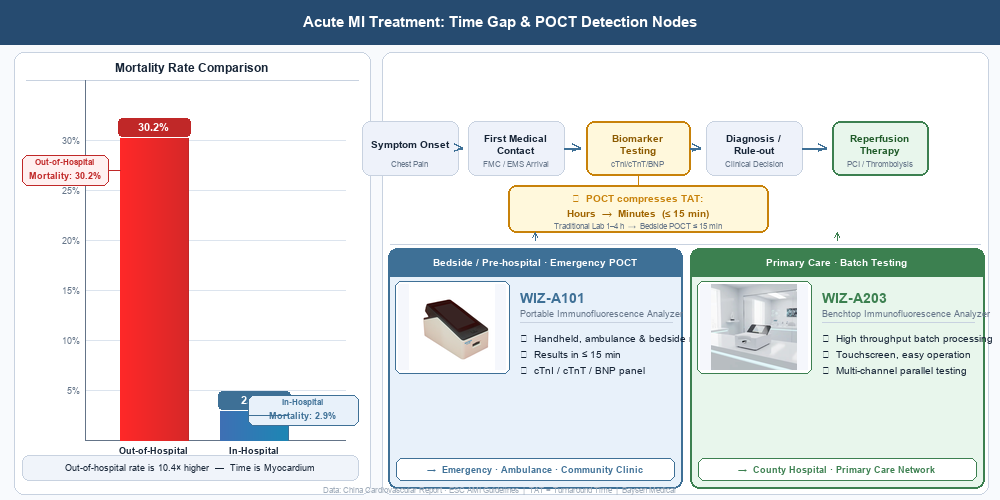
Yet the gap between the ideal and reality remains wide. According to the China Cardiovascular Health and Disease Report 2024 released by the National Center for Cardiovascular Diseases, China has more than 3 million new myocardial infarction (MI) cases each year, with an incidence of 62 per 100,000. Patients under 40 now account for 15% of cases. Out-of-hospital mortality from acute MI is as high as 30.2%, and reaches 38.7% in rural areas. By contrast, in-hospital mortality within the chest pain center network fell below 3% for the first time in 2025, to approximately 2.9%. This sharp “out-of-hospital versus in-hospital” difference suggests that what often determines survival is not only in-hospital treatment capacity, but the time lost before the patient reaches an effective point of care. One easily overlooked bottleneck in the interval between symptom onset and confirmed intervention is the turnaround time of cardiovascular biomarker testing.
Cardiac troponin is the core biomarker for diagnosing acute myocardial infarction. The 2025 ACC/AHA guideline for acute coronary syndromes recommends high-sensitivity cardiac troponin (hs-cTn) 0/1-hour or 0/2-hour rapid diagnostic pathways to enable earlier rule-in or rule-out in the emergency department. However, central laboratory testing often takes hours, which is difficult to reconcile with the “120-minute” requirement. Point-of-care testing (POCT) for hs-cTn is changing this picture. A systematic review showed that POCT hs-cTn assays have no significant difference from laboratory testing in diagnostic accuracy for acute MI, with sensitivity and negative predictive value both exceeding 99%, while significantly shortening reporting time and accelerating clinical decisions. This means that moving reliable testing closer to the emergency department, chest pain center, and even primary-care first-contact settings is a practical way to compress “treatment delay.”
In this direction, our cardiovascular testing portfolio provides two complementary pillars. The WIZ-A101 portable immunoassay analyzer is positioned as a “palm laboratory”: compact, battery-powered, and capable of a throughput of 150 T/H. It can run cardiac troponin I and other cardiovascular marker reagent cards, making it suitable for emergency bedside testing, chest pain centers, primary-care institutions, and prehospital settings—turning “samples waiting for instruments” into “instruments waiting for samples.” The WIZ-A203 multi-channel immunoassay analyzer addresses batch testing needs in primary-care institutions and small-to-medium laboratories: it offers 10-channel parallel testing, one-key switching between colloidal gold and fluorescence methodologies, high precision and low CV in fluorescence mode, a built-in temperature control module for stable results in different environments, and a throughput of up to 70 T/H. Together, the two instruments cover cardiovascular marker testing scenarios from “single-sample rapid triage” to “multi-sample batch screening,” so that hs-cTn testing is no longer confined to the central laboratories of large hospitals.
The meaning of China Chest Pain Day is not only to raise public awareness of the “two 120s,” but also to push every optimizable step to truly shorten those 120 minutes. For a manufacturer of medical reagents and instruments, delivering accurate, rapid, and accessible cardiovascular biomarker testing to the places closest to patients is the most practical response to “time is muscle.” When a troponin report changes from “waiting for results” to “results available immediately,” the golden treatment window truly becomes something that can be seized.
Post time: Nov-16-2026