



Gastric Cancer Awareness Day | From Precision H. pylori Testing to Tumor Marker Monitoring: Supporting Early Gastric Cancer Screening with Full-Scenario Diagnostics
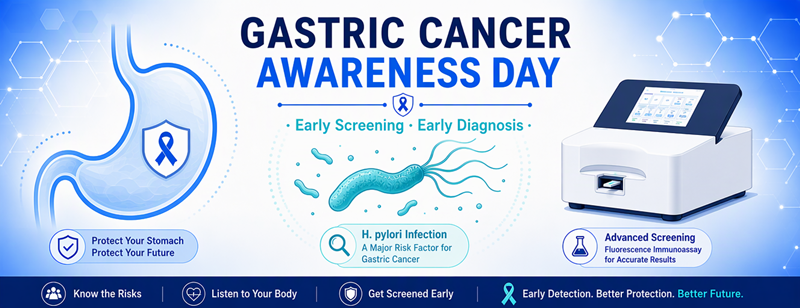
November 29 is Gastric Cancer Awareness Day in China, and this year’s core advocacy remains “early screening, early diagnosis,and early treatment.”Helicobacter pylori (H. pylori) has been classified by the World Health Organization as a Group 1 carcinogen. Long-term infection can progress along the pathway of “chronic gastritis—atrophy—intestinal metaplasia—dysplasia—gastric cancer,” and eradication of H. pylori has been shown to effectively interrupt this process. For laboratory and gastroenterology departments in healthcare institutions, the question is not whether to test, but how to detect H. pylori accurately, comprehensively, and traceably across different clinical scenarios.
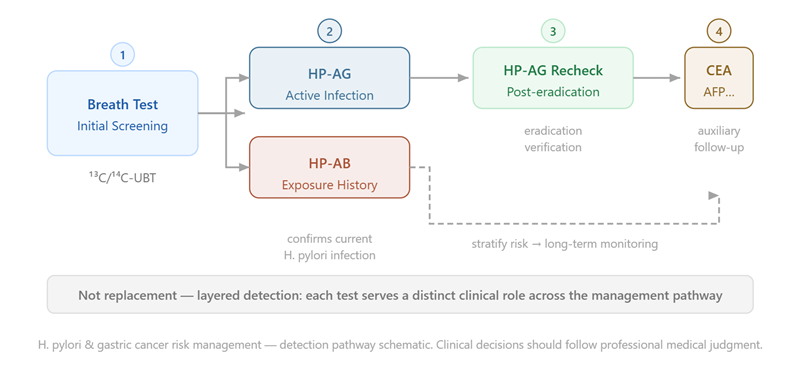
To meet this need, we offer a continuous solution spanning breath-based initial screening, rapid antigen/antibody testing, and fluorescence quantitative analysis with adjunctive tumor marker monitoring. The C13/C14 urea breath test is widely recognized domestically and internationally as one of the gold standards for H. pylori detection, offering non-invasive sampling and high accuracy. C13 is non-radioactive and suitable for pregnant women, children, and populations with higher safety requirements; C14 is cost-effective and well suited to health checkups and large-scale screening. By combining the two, testing can be flexibly selected according to the target population.
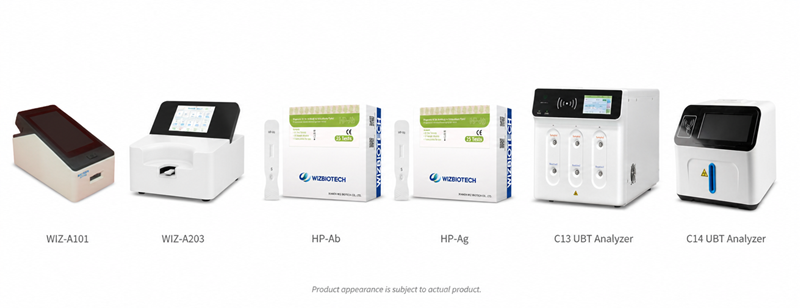
Beyond breath testing, the WIZ-A101 and WIZ-A203 portable immunoassay analyzers can be paired with HP-AG and HP-AB reagents to achieve quantitative detection of H. pylori antigen/antibody using time-resolved fluorescence immunochromatography, rather than merely providing a qualitative negative/positive result. HP-AG detects fecal antigen and directly reflects active infection status, making it suitable for confirming current infection and assessing treatment efficacy after eradication therapy. HP-AB detects antibodies and is suitable for epidemiological screening and indication of past infection, with convenient operation and fast result reading. For clinical scenarios that require determining “whether infection is currently present” and “whether eradication has been achieved after treatment,” this linkage of rapid screening, precise quantification, and treatment efficacy tracking offers more practical value than a single method.
In addition, we offer tumor marker tests such as CEA and AFP, which can be used for adjunctive monitoring and combined assessment in high-risk populations for gastric cancer. It should be noted that tumor markers alone have limited sensitivity for early gastric cancer screening and are more suitable as supplementary information in comprehensive clinical judgment and disease follow-up, rather than as a replacement for gastroscopy or etiological testing for H. pylori.
The significance of Gastric Cancer Awareness Day lies in turning “early screening and early treatment” from an advocacy message into an actionable testing pathway. From the initial screening and triage provided by breath testing, to the quantitative confirmation and treatment efficacy tracking enabled by HP-AG/HP-AB, and further to the adjunctive monitoring provided by tumor markers, we hope to help more healthcare institutions safeguard the “first line of defense” in screening and gastric cancer risk management through diagnostic tools covering different levels of healthcare settings.
Post time: Nov-25-2026