



May 19th is World IBD Day, dedicated to raising public awareness of inflammatory bowel disease (IBD) and caring for IBD patients. IBD mainly includes ulcerative colitis (UC) and Crohn’s disease (CD). It is a chronic, relapsing inflammatory bowel condition that significantly impairs patients’ quality of life. On this occasion, we are pleased to share a latest research study conducted by Union Hospital, Tongji Medical College, Huazhong University of Science and Technology, which used the Calprotectin Assay Kit (Fluorescence Immunochromatography Assay, FICA) and the WIZ-A202 Continuous Immunoassay Analyzer developed by us, providing important references for the disease management of UC patients.
Research Background: Seeking Better Non-invasive Monitoring Indicators for UC
Colonoscopy is the “gold standard” for assessing endoscopic disease activity in UC, but it is invasive and poorly tolerated by patients, making frequent monitoring difficult. Serum markers such asC-reactive protein (CRP) and erythrocyte sedimentation rate (ESR) lack specificity and correlate poorly with intestinal inflammation.
Fecal calprotectin (FC), an intestine-specific inflammatory marker derived from neutrophils, has become an important non-invasive tool in IBD management. However, FC thresholds vary significantly across different detection methods due to the lack of standardized cut-off values. Fluorescence immunochromatography assay (FICA) is a rapid and simple detection method, but its optimal clinical cut-off values require further validation.
Research Objectives and Methods
1)Research Objectives: This study aimed to evaluate the correlation between FC detected by FICA and clinical/endoscopic disease activity in UC, and to determine the optimal cut-off values for predicting disease activity.
2)Study Population: 110 patients diagnosed with UC who were hospitalized at Union Hospital, Tongji Medical College, Huazhong University of Science and Technology between January 2021 and June 2022.
3)Detection Method: FC was measured using the WIZ-A202 Continuous Immunoassay Analyzer and the matching Calprotectin FICA Kit from us
4)Assessment Criteria: Clinical activity was assessed by partial Mayo score (pMS); endoscopic activity was assessed by the Ulcerative Colitis Endoscopic Index of Severity (UCEIS) and Mayo Endoscopic Score (MES).
Core Research Results
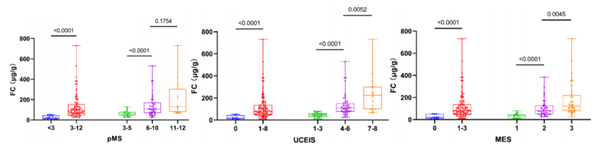
1. FC levels significantly correlated with disease activity.
FC levels showed significant positive correlations with pMS (r=0.609), UCEIS (r=0.751), and MES (r=0.635) (all P<0.001), with better correlation than CRP and ESR. The correlation between FC and endoscopic activity was particularly strong.
2. Optimal cut-off values determined.
| Prediction Target | Optimal cut-off (μg/g) | Sensitivity | Specificity |
|---|---|---|---|
| Clinical activity (pMS ≥ 3) | ≥57.38 | 78.02% | 100% |
| Endoscopic activity (UCEIS ≥ 1 / MES ≥ 1) | ≥53.30 | 71.57–73.74% | 100% |
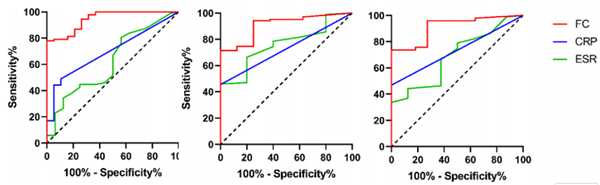
3. FC showed excellent performance in discriminating active UC.
ROC curve analysis showed that the AUC of FC for predicting clinical activity was 0.9456, and for predicting endoscopic activity was 0.9075 (UCEIS) and 0.9118 (MES), all significantly superior to CRP and ESR.
4. Clinical remission does not equal endoscopic remission.
Among 11 patients who achieved clinical remission (pMS < 3) but still had endoscopic activity, 10 (90.91%) had FC levels below 53.30 μg/g. This suggests that even when FC levels are normal, some patients may not have achieved endoscopic healing, and colonoscopy still cannot be completely replaced.
Research Conclusions
- FICA-based FC detection is a good predictor of clinical and endoscopic activity in UC.
- A cut-off of 57.38 μg/g is recommended for assessing clinical activity.
- A cut-off of 53.30 μg/g is recommended for assessing endoscopic activity (a lower threshold helps improve sensitivity).
- FC can effectively reduce unnecessary colonoscopies and optimize the utilization of medical resources.
Advancing Precision Diagnosis and Treatment of IBD-Baysen in Action
Xiamen Baysen Medical ‘s independently developed Calprotectin Assay Kit (Fluorescence Immunochromatography Assay) and WIZ-A202 Continuous Immunoassay Analyzer offer the following advantages:
Calprotectin Assay Kit (Fluorescence Immunochromatography Assay)

Positioning: Clinical Quantitative Testing
FICA uses a double-antibody sandwich method to detect FC, shows good correlation with ELISA, and can effectively assess IBD activity.
Product Advantages:
- Fast and Simple: Results available in just 15 minutes
- Easy Operation: No complex equipment required; suitable for medical institutions at all levels
- Reliable Results: Good correlation with clinical and endoscopic activity
- Clear Sample Requirements: Standardized sampling process ensures testing quality
Applications: Outpatient screening, inpatient monitoring, treatment follow-up, and research collaboration
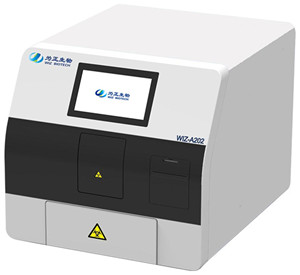
Product Advantages:
- Full Sample Type Compatibility: Capable of testing blood, urine, and fecal samples
- Good Compatibility: Accommodates colloidal gold method, latex method, and fluorescence immunoassay
- Biologically Safe: Automatic waste card collection for convenient and safe disposal
- Continuous Sampling: Equipped with a multi-position incubation chamber, enabling uninterrupted sample loading and testing
- Intelligent Recognition: Automatically identifies test items and methodology
- Data Interoperability: Supports connection with hospital LIS (Laboratory Information System)
This study confirms the important clinical value of FICA-based FC detection in UC management, providing a powerful tool for non-invasive monitoring of IBD patients.
Globally, the incidence of IBD is rising continuously. Early diagnosis, standardized treatment, and scientific monitoring are key to improving patient outcomes. As a non-invasive, convenient, and highly specific biomarker, fecal calprotectin is transforming the disease management model for IBD.
We Baysen/Wizbiotech remains committed to the research and optimization of IBD-related diagnostic products, providing clinicians and patients with more accurate and convenient testing solutions, and working together to protect intestinal health.
Post time: May-19-2026